
The Burhaniya in the Tradition of Great Sufi Masters
The Burhaniya understands itself as a tariqa in the tradition of numerous earlier Sufi masters, among them Junayd of Baghdad († 910). His teaching on sobriety in spiritual experience, and his insistence that mystical insight remains empty without the Sharia and a sense of responsibility within the community, continue to shape our understanding of Sufism to this day.
Sufism is not reached by prayer and fasting alone, but by a heart grounded in serenity and a soul shaped by generosity.
Dschunaid of Bagdad
Al-Ghazali († 1111) is also of great importance to us, for he opened the path once again in a different way. He united scholarship and spirituality, outward obligations and inner purification, showing that both are needed in order to attain true understanding. His work profoundly shaped not only Sufism, but the intellectual and spiritual life of Islam as a whole.
Abu al-Hasan ash-Shadhili († 1258), in turn, taught that one need not seek God only in seclusion. He encouraged people to stand fully within life — in work, family, and daily concerns — and to practise mindfulness and inner awareness there. For many seekers, this was a liberating opening.
Ibn ʿAtaʾ Allah al-Iskandari († 1309), one of the most important representatives of the Shadhiliyya, expressed these teachings in a clear and accessible language. His Hikam (Aphorisms of Wisdom) remain among the most influential texts of Islamic mysticism. He combined practical guidance with deep spiritual insight, making the teachings of the Shadhiliyya accessible to a wide circle of seekers.
Sometimes He gives while depriving you,
and sometimes He deprives you in giving.
From the Words of Wisdom — al-Hikam — by Ibn ʿAtaʾ Allah
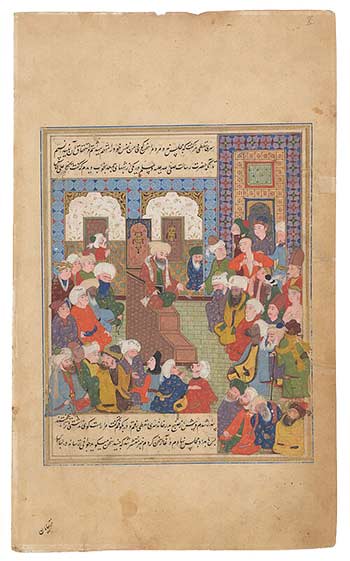
Wikimedia Commons
The names of Abu al-ʿAbbas al-Mursi and Salam ibn Bashish are also linked to this tradition. Each contributed in his own way to transmitting and consolidating the teachings of the Shādhiliyya, whether through an intensified focus on inner training or through embedding the path within the social life of their time.
In the twentieth century, this heritage was renewed and carried forward by Sheikh Mohammed Osman al-Burhani († 1983). He conveyed the wisdom of his forebears in the language of our era and accompanied people across the world. His emphasis lay on knowledge, prayer, and the personal guidance of those seeking the path. Through him, the Burhaniya took on its present form — a living continuation of a long tradition that stretches from the early masters to our own time.
