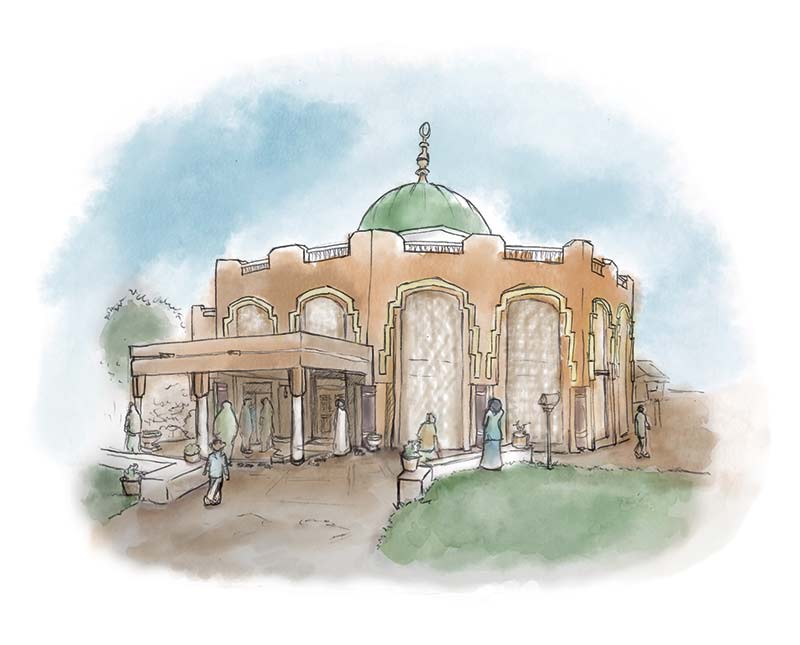
Origin and Transmission of the Tariqa Burhaniya
Our Tariqa is the Sufi order of Sayyidi Ibrahim al-Qurashiyy ad-Disuqi.
It was founded in the 13th century by him and his uncle, Sayyidi Abul Hassan ash-Shadhuli. From this origin comes its full name: Tariqa Burhaniya Disuqiya Shadhuliya.
The inner knowledge of this order, its prayer texts, and its spiritual practices were rediscovered and revived in the 20th century by Maulana Shaykh Mohammed Osman Abduh al-Burhani (1902–1983) from Sudan, the grandfather of the current Shaykh.
The spiritual lineage (silsila سلسلة) — the chain of the shaykhs of the Tariqa Burhaniya — traces back to the Prophet Muhammad ﷺ.
The principal links in our spiritual chain are:
- Sayyidi al Sheikh Mohammed Ibrahim Mohammed Osman
- Sayyidi al Sheikh Ibrahim Mohammed Osman
- Sayyidi al Sheikh Mohammed Osman Abduh al-Burhani
- Sayyidi Ahmad Arabi al Sharnubi
- Sayyidi Musa Abu al Umran
- Sayyidi Ibrahim al Qurashi al Disuqi
- Sayyidi Abul Hasan al Shaduli
- Sayyidi Abdu al Salam ibn Bashish
- Sayyiduna wa Maulana al Imam al Husain
- Sayyiduna wa Maulana al Imam al Ali
- Ziyadatan fi Scharaf al Mustafa, salla'llahu alaihi wa sallama
The name of our Ṭarīqa means in detail:
Burhan – “the Proof”, a byname of Sayyidi Ibrahim ad-Disuqi
Disuqiya – refers to the town of Disuq in Egypt, where Sayyidi Ibrahim lived.
Shadhuli – the uncle of Sayyidi Ibrahim, Sayyidi Abul Hasan al Shadhuli
The Tariqa Burhaniya experienced a significant revival under the leadership of Sheikh Mohammed Osman Abduh al Burhani (†1983), and later his son, Sheikh Ibrahim Sheikh Mohammed Osman (†2003). Under the current spiritual guidance of Sayyidi al Sheikh Mohammed Ibrahim Mohammed Osman, the Tariqa continues to flourish. Hundreds of Burhani communities have spread across the globe. (→ Burhaniya Worldwide) Numerous communities have been established in many countries across several continents.
This far-reaching growth over recent decades is rooted in a profound, living heritage — a heritage we aim to highlight through the reports and pages that follow.

This wide reach of the Tariqa Burhaniya is rooted in a deep and living heritage—
a heritage that we seek to make visible in the following accounts and on these pages.
Sayyidi al Sheikh Mohammed Osman Abduh al-Burhani
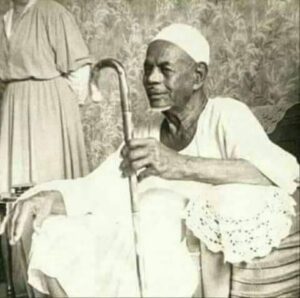
Sayyidi Shaykh Muhammad Uthman Abduh al-Burhani was born around the turn of the 20th century in Halfa, in what is now Sudan. At the age of only ten, after earnest supplication, he was admitted into the Tariqa Burhaniya by his uncle. At that time, however, there was no spiritual teacher to guide him. There was no one to instruct him in the spiritual practices or to accompany him on his inner path. Thus, he spent most of his time in the mosque, deeply immersed in the study of Islamic law and the Sharia.
Djabal al-Awliya (the Mountain of the Saints) – an early vision of Maulana
In a dream he had while still a child, the great saint Sayyidi Ahmad al-Badawi appeared to him. He took the child by the hand and led him to a mountain near Khartoum – later known as Djabal al-Awliya, the Mountain of the Saints. Upon reaching it, Sayyidi Ahmad al-Badawi struck the rock with his hand. The mountain opened and revealed a cave.
“Pray in this cave,” he commanded.
When he awoke, the young Mohammed Osman was deeply moved and full of questions. What did this place mean? Where could it be found? He turned to the head of a nearby settlement, a man named Wasim, and asked him about the mountain. Wasim confirmed that the place was indeed known as Djabal al-Awliya – so named since earlier times, when devout saints had prayed there in a hidden cave.
Mohammed Osman set out in search of the place and found the site from his dream: a cave with a fine, white sandy floor. Deep within it, the direction of prayer, the qibla, was indicated. There he prayed for the chain of shaykhs of his order, whose names and sequence he knew only incompletely at that time. In later years, he returned to this cave and spent six months there in retreat.
During this period of inner searching, Mohammed Osman spent many nights in prayer and contemplation. He experienced visions in which several of the great saints appeared to him. Through these encounters, he received the first portions of the Awrad (“the Source”) – the distinctive prayer texts of the Tariqa Burhaniya.
The Blind Teacher
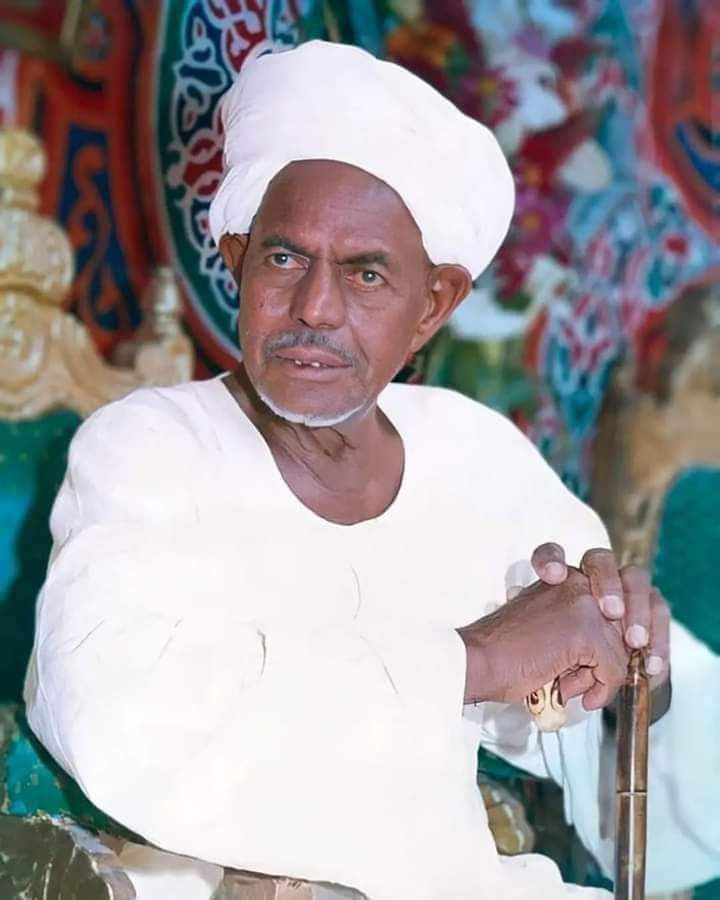 One day, a blind man from Egypt entered the mosque. He approached Mohammed Osman and asked, “Will you not invite me to sit?” Mohammed Osman replied, “This is a house of God – everyone is welcome here.” The stranger turned away, performed the two units of prayer recommended upon entering a mosque, and then said,
“Sayyidi Ibrahim ad-Disuqi has sent me to instruct you in the Awrad.”
He stayed with Mohammed Osman for seven months, teaching him all the details of the Awrad and the special practices of the Tariqa Burhaniya. During this time, Mohammed Osman secretly prayed often that his teacher’s blindness might be healed. Yet one day, the man walked through the room and named the colors of the objects around him. Though blind, he did not need eyesight to see.
After seven months, the Egyptian took his leave, saying he would now return to Disuq, to the grave of Sayyidi Ibrahim, near which his home lay. Yet when Mohammed Osman later visited Disuq and inquired about him, no one remembered the man. No one had ever heard of him.
In the time that followed, Mohammed Osman discovered ancient manuscripts hidden in clay jars by his ancestors during the book burnings by the Mahdi (1881–1899). Among these was the complete Awrad of the Tariqa Burhaniya – a treasure that he now preserved and transmitted for his students.
How Maulana Received the Leadership of the Tariqa
Sayyidi Shaykh Muhammad Uthman Abduh al-Burhani recounted:
“In sleep and in visions, I saw a locomotive approaching me with only a single carriage. It stopped directly at my feet. I realized that this train came from Disuq—the city of my Shaykh. For forty nights, this vision repeated itself until it became tangible reality. I opened the carriage and found a coffin inside. When I lifted the cover, there lay a body wrapped in a white cloth. I lifted it further and discovered a green cloth beneath it. I lifted that as well, and underneath appeared a yellow cloth.”
These three colors are symbolic of the Tariqa:
White – the cloth of the Prophet Muhammad ﷺ, passed down to Sayyidi Ibrahim; it represents the light of the Sharia, the outer law.
Green – the color of Sayyiduna al-Husain, representing the heart and inner knowledge.
Yellow – the color of Sayyidi Abul Hasan ash-Shadhuli, symbolizing the path of purification: overcoming the seven stages of the ego and advancing on the inner path.
When Maulana had lifted the cloths, he saw the feet of the body – and realized they resembled his own. In that moment, the presence of numerous saints was revealed to him, including Sayyidi Abul Hasan ash-Shadhuli.
“Who is this deceased?” he asked.
“It is Ibrahim ad-Disuqi,” came the reply.
Maulana was shaken and wept. All his efforts and striving seemed in vain – if the Shaykh had truly passed away. Yet then Sayyidi Ibrahim ad-Disuqi himself appeared and said:
“The deceased represents my Tariqa. And you are chosen to give it new life.”
Maulana hesitated. For two months he refused to take on this responsibility. Then the saints appeared to him again – this time accompanied by Sayyiduna Imam al-Husain. It is said that one cannot refuse the word of Imam Husain. He spoke:
“My son, hesitate not. Whoever receives a task is also granted support. Take responsibility and ask for what you need – it will be given to you.”
Finally, Maulana Mohammed Osman consented, but he set conditions:
No student of his should fall into a state of ecstatic rapture (maǧzūb), and there should be no spiritual retreats (khalwa) within the Tariqa.
These and sixty additional conditions were written into a contract, signed by Sayyidi Ibrahim and Sayyiduna al-Husain.
Thus, a new beginning of the Tariqa Burhaniya was gifted to us under the spiritual guidance of Maulana Shaykh Mohammed Osman Abduh al-Burhani.
Maulana Shaykh Mohammed Osman – called Sayyidi Fahruddin (“Pride of the Religion”) by his students – passed from this world on April 5, 1983. His grave (maqam) in Khartoum, Sudan, is today a widely visited and blessed place of contemplation, remembrance, and spiritual connection.
More Infos about → Sayyidi al Sheikh Mohammed Osman Abduh al-Burhani